
67 Frogmore Street
About the Building | Recent History | Previous Occupiers | Other Information


| Address: | 67 Frogmore Street |
| Present Occupier: | Specsavers Opticians |
| Present Owner: | |
| Ground Floor: | Opticians |
| Other Floors: | Opticians |
| Date when first used by present occupier: |
About the Building
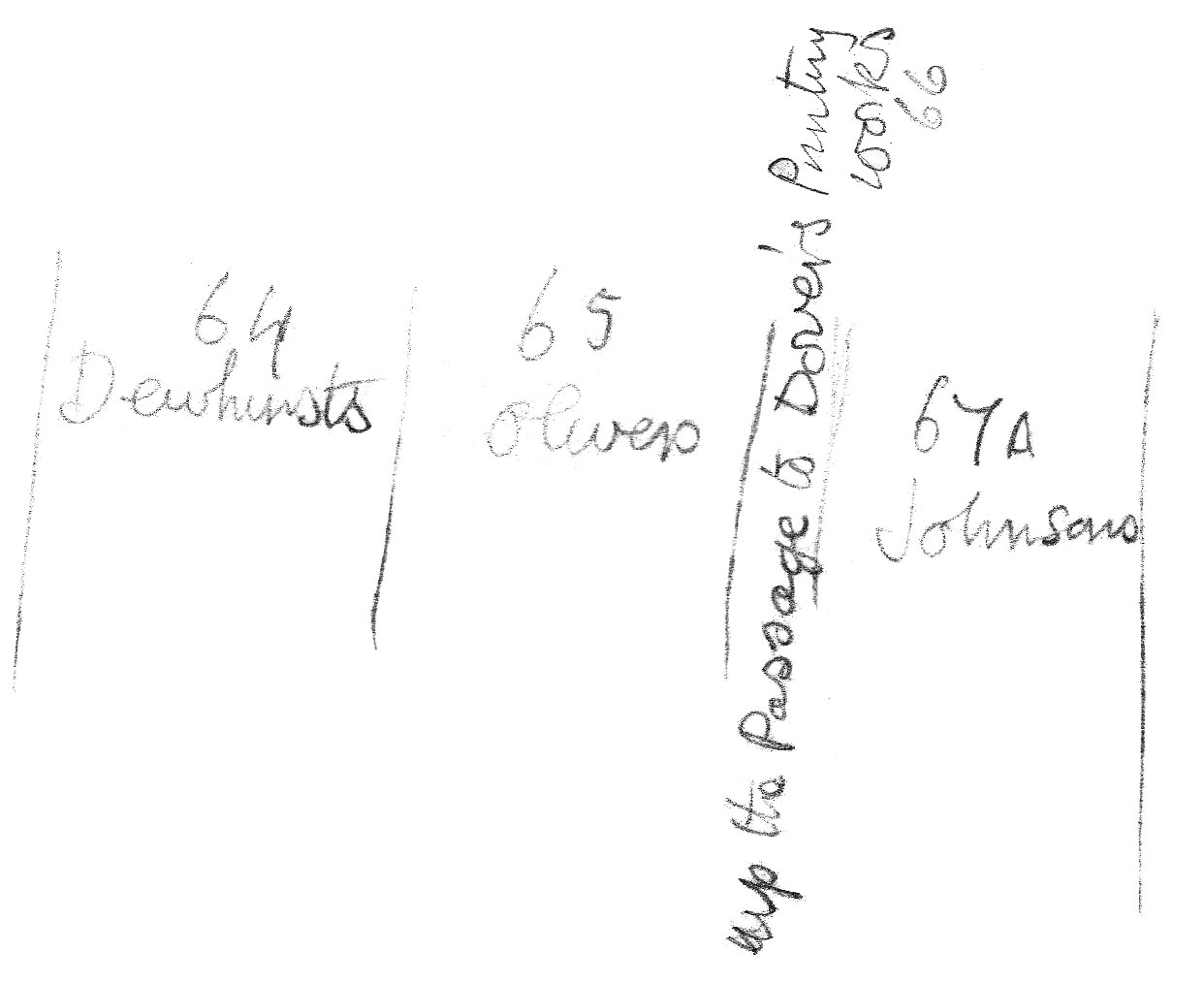
The records of this building appear to apply to no 67. The current users stated that they are no 66. The current no 67 is behind and was listed on the original survey as no 66.
Recent History
2006, 2005: Specsavers opticians
2000: Specsavers opticians, Advert: “celebrating 10 years at this site” June 2000
1993, 1991: Specsavers opticians
1988: W H Smith Newsagent, bookshop.
1975 – 1980 Peppercorns ladies clothing. Owner Bolloms.
1967: Johnson cleaners Advert “assistant required”
1960: 67A: Johnsons dry cleaners
1959: at nos 67 & 67A: Johnson dry cleaners,
1958: at 67A: Johnson’s cleaners, no 67: Heinz & Allen, sheet music, instruments, advertising tickets for Betram Mills Circus.
1957: at 67A: Johnsons dry cleaners
1938: Leoni Hairdresser
Previous Occupiers
| Year | Name | Detail | Source |
| 1937-75 | Johnson Bros Ltd | Dyers & Cleaners | Rate book |
| 1937 | Frederick Climson/ Leoni Ltd/ Johnson Cleaners at 67A from 1910 |
Cabinet maker/Hairdresser Dry cleaners |
Kelly |
| 1934 | Frederick Climson/ Leoni Ltd/ Johnson Cleaners at 67A from 1910 |
Cabinet maker/Hairdresser Dry cleaners |
Kelly |
| 1930 | Frederick Climson/ Leoni Ltd/ Johnson Cleaners at 67A from 1910 |
Cabinet maker/Hairdresser Dry cleaners |
Car/Npt & Dis |
| 1926 | Frederick Climson/ Leoni Ltd/ Johnson Cleaners at 67A from 1910 |
Cabinet maker/Hairdresser Dry cleaners |
Kelly |
| 1921 | J Phillips & Sons with showrooms behind in no 66, possibly on the first floor. Also Johnsons Bros at 67A |
Cabinet makers, uphoster, undertaker & venetian blind maker Dyers |
Kelly |
| 1914 | J Phillips & Sons with showrooms behind in no 66, possibly on the first floor. Also Johnsons Bros at 67A |
Cabinet makers, uphoster, undertaker & venetian blind maker Dyers |
Kelly |
| 1910 | J Phillips & Sons with showrooms behind in no 66, possibly on the first floor. Also Johnsons Bros at 67A |
Cabinet makers, uphoster, undertaker & venetian blind maker Dyers |
Kelly |
| 1906 | J Phillips & Sons | Cabinet makers, uphoster, undertaker & venetian blind maker Dyers |
Kelly |
| 1901 | J Phillips & Sons | Cabinet makers, uphoster, undertaker & venetian blind maker Dyers |
Kelly |
| 1895 | J Phillips & Sons | Cabinet makers, uphoster, undertaker & venetian blind maker Dyers |
Kelly |
| 1891 | J Phillips & Sons | Cabinet makers, uphoster, undertaker & venetian blind maker DyersCabinet makers, uphoster, undertaker & venetian blind maker Dyers |
Kelly |
| 1884 | J Phillips & Sons | Cabinet makers, uphoster, undertaker & venetian blind maker Dyers |
Kelly |
| 1879 | J Phillips & Sons | Cabinet makers, uphoster, undertaker & venetian blind maker Dyers |
Thacker |
| 1877 | J Phillips & Sons | Cabinet makers, uphoster, undertaker & venetian blind maker Dyers |
Owen |
| 1875 | Benjamin Jones | Tailor,draper & hatter | Mer & Croc |
| 1871 | Benjamin Jones (he was at no 60 in 1865) | Tailor,draper & hatter | Kelly |
| 1865 | John Watkins Junior (his father was in 7 Cross Street) | Plumber, painter & glazier | |
| 1862 | Michael William Hands (or Hansby) | Surgeon | Morris & Co |
| 1851 |
James Millward |
Roman Catholic Priest | Census |
| 1822 | Evans & Preece | Printers & Glaziers | Pigot |
Other Information

Information from Jane Hussey, granddaughter of John Frederick Stroyd-Clempson
John Frederick (Fred) Stroyd-Clempson lived almost all of his married life at this property. He was apprenticed to Mr. Phillips, cabinet maker 1891 – 1899 and himself became a master cabinet maker over time. He lived with the Phillips who loved him like a son and when Mr. Phillips met his untimely death (I think he had a heart attack on Newport station) the business was bequeathed to my grandfather. Fred had time out for the Boer war and did not return from S. Africa until 1908 when he rejoined the firm. Again he was away throughout the duration of WW1 and again returned to take over the business, but could not make a go of it as his employees would undercut him (this according to my mother). So living above the shop on two floors at No. 67 he worked in a shed at the bottom of the garden all his life making & repairing furniture, re-upholstering chairs, and replacing ticking in mattresses. The big workshop beside 67 was taken over by Dovers Printers which I well remember. He did work for Neville Hall, where he met my grandmother in service there at the time, the Llewellyns, re-upholstered the chairs at the Angel, made pews for Holy Trinity church, restored much of the woodwork at Patrishow church and much more.
As I remember 67 in the 50’s/60’s Johnson’s the Cleaners were beneath the living quarters, so we had to climb the linoleum covered stairs to visit my grandmother which we did for holidays etc. The first floor had a huge sitting room at the front with my grandmother’s treadle sewing machine in it, a huge upright weaving loom and the usual table & chairs etc. The dining room behind was equally massive with an open fire on which my grandmother always had the kettle on the hob. At the other end of this room you went down 3 steps into the scullery which is where the tin bath hung (no bathroom), the cooking and washing was done, and this small room had a window onto the back garden, where halfway up the path was the only toilet and then the path led up to my grandfather’s workshop. There were huge corrugated iron gates at the back on the left-hand side which opened up onto the alleyway which ran alongside 67 and which no doubt would have been used to load and unload any furniture etc.
Climbing more linoleum-covered stairs, all painted a dingy brown, were the 3 huge bedrooms. My grandparents had the middle one which had windows to the front. My sister and I slept in the back bedroom with windows to the garden and there was a further guest room at the front. No doubt my mother and her brother had one each of these two rooms in their day. Each one had a washstand with ewer and basin and of course a chamber pot under the bed. All the floors were covered by the same thin linoleum which was cold to the feet an which when polished was slippery.
In the corridor leading to the front door on the ground floor beside the shop and all the way back round the stairs to the back door there would be furniture lined up awaiting collection.
My grandparents were forced to move out when my grandfather’s leg was amputated (an old war wound became gangrenous) and the council housed them on the Ysguborwen estate. We spent many a happy childhood holiday staying with my grandparents, our grandmother was lovely and an excellent cook. She had goods brought to her from grateful customers on market day and she would invite them in for a cuppa and cake. My granddad would sit at the head of the table and smoke his baccy pipe and my grandmother always laid an extra place for “the uninvited guest” (I don’t know if anyone would turn up.)
To make ends meet in the depression and when my grandfather also had a long depressive illness grandma took in lodgers and during WW2 she had an evacuee from Liverpool living with them.
If you have any further information about this property please email alhsresearch@email.com